Can AI build my business website? An honest look at 2026
Yes, it can. The better question is whose AI site wins, and what humans still do better. A field report from an agency that uses AI daily.
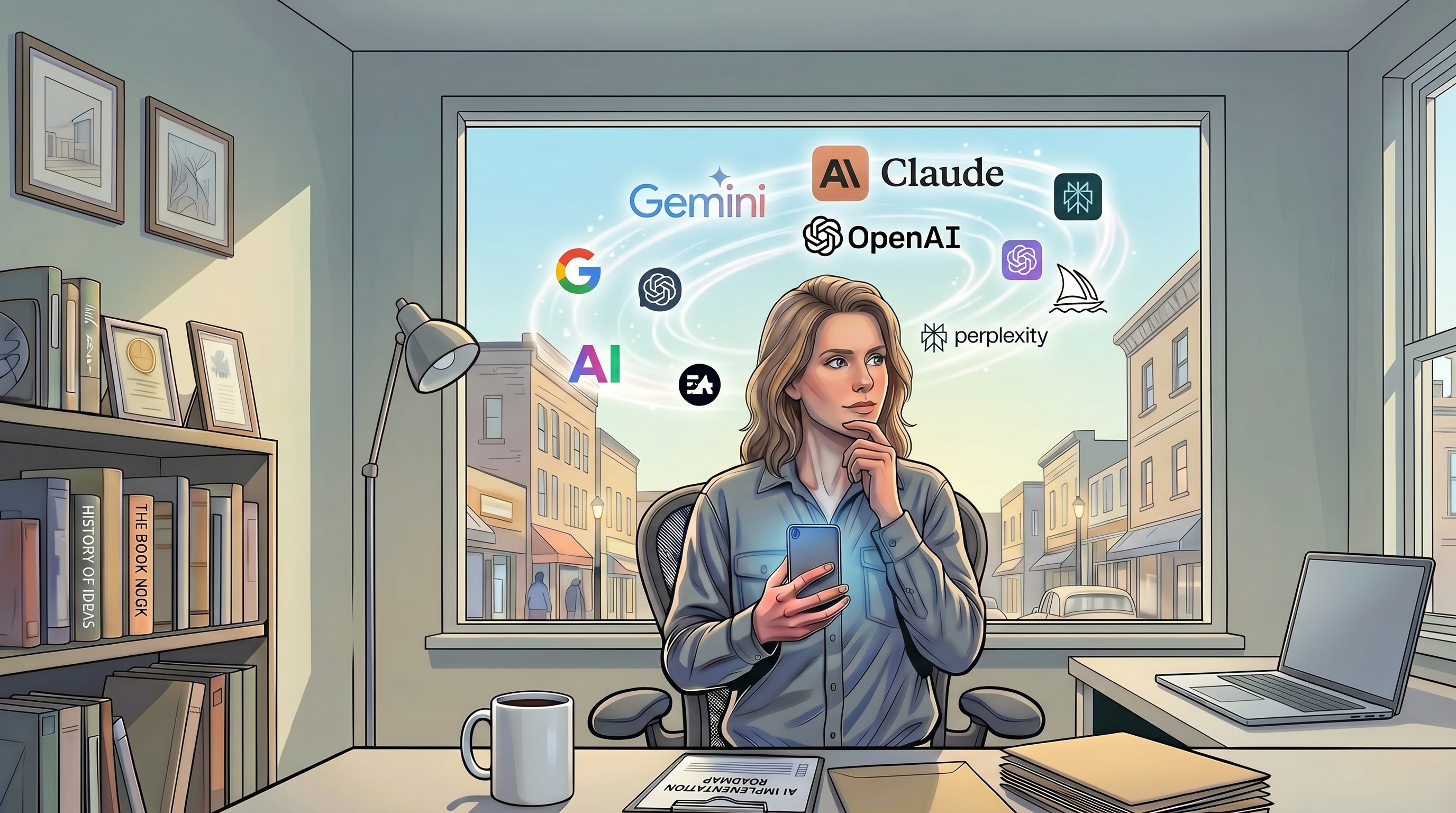
Every business owner we talk to in 2026 is asking the same thing: can't AI just build my website for me? It's a fair question. The marketing certainly suggests it. One platform, one prompt, sixty seconds, and apparently you have a business. So let's answer it honestly. Yes. AI can build a website. That part is true. But that's not actually the question worth asking. The real question is whose AI site wins, and that answer is more complicated than the AI-builder ads make it look.
What AI is genuinely good at right now
Let's be fair to the technology first. We use AI extensively at UpEngine. So do most agencies worth their salt. AI in 2026 is genuinely good at a real list of things: drafting first-pass copy that you'd otherwise stare at a blank page for, generating images at speed, scaffolding the basic structure of a page, filling templates with reasonable defaults, summarizing competitor sites, suggesting metadata, and automating repetitive build tasks that used to eat hours.
If you're a business owner thinking can I get a basic site up using AI tools alone, the answer is yes, and faster than ever. That's a real shift, and it matters. But "a basic site up" is not the same as "a site that beats the three other local businesses competing for the same search results." Those are different problems, and most AI marketing conflates them on purpose.
What AI is still bad at, specifically
Here are the things AI still struggles with in 2026, in order of how much they matter to a local business website:
1. SEO testing
This is the big one. AI doesn't run SEO experiments. It summarizes what humans have already published about SEO. That training is always behind the actual state of the algorithm, by months, sometimes years. Google rolls out a ranking change in March; the AI doesn't know about it until enough humans have written articles about the change to feed back into training data. By then the early movers have already adjusted. SEO changes constantly and AI is a lagging indicator.
2. Taste
AI doesn't have a preference between two designs. It has a probability distribution over what designs look like in its training data. Those are different things. Ask AI for "a clean, modern, conversion-focused homepage" and you'll get something that matches the average of every page it's seen with those words attached. The output is, by construction, average, a recycled remix of past work. That's fine if you're trying to look like everyone else. It's a problem if you're trying to stand out from three competitors in the same town.
3. Business context
A roofing lead converts differently than a salon lead. A high-ticket HVAC customer thinks about a website differently than a $40 manicure customer. The signals that move one don't move the other. AI doesn't know any of that for your specific business, only the average. You can prompt it harder, but at that point you're doing the work of a marketer who happens to be typing into a chat window.
4. Predicting behavior change
What people clicked on in 2023 isn't what they click on in 2026. The hero patterns that converted three years ago don't convert today. AI's output reflects the past, it can't anticipate that visitor behavior is shifting next quarter, only summarize what already happened. Humans who run sites notice the shift first and adjust before the AI catches up.
The competition trap
Here's the part the AI-builder marketing never mentions. AI doesn't stop your competitors from using AI too. The same tools that let you build a site in an afternoon let the three other roofers in town build sites in an afternoon. So while it's easier than ever to make a site, it's not any easier to rank one. The competition leveled up at the same time you did.
The question stops being "can AI build my site" and becomes whose AI site wins. That answer comes down to whoever is doing the parts AI still can't: human SEO testing, taste, business context, brand instinct. We use AI heavily for many tasks. So do our competitors. Human expertise is still the edge.
There's a real window right now, business owners who actually understand SEO, AEO, and GEO can run ahead of competitors who are letting AI do everything passively and assuming it'll be enough. That window doesn't last forever. As AI tooling levels up and as more businesses learn how to use it well, the gap closes. But for the next year or two, the people who pair AI with human expertise are going to outrun the people who use AI alone.
"Can't I just do this myself with AI?"
Yes, you can. And you can also wash your car. Every single week. The catch isn't building the thing once, it's that a website is not a one-time object. Sites need to update. Strategy needs to be implemented, then pivoted. Conversion needs to be tested, then tested again. AI, left to run on its own, doesn't do any of that. It hands you a snapshot and walks away. The work that actually moves the needle is the work that happens after the site exists.
That's the real split between doing it solo with AI and having a team that uses AI on your behalf. It's less "who can make a website" and more "who keeps showing up after launch." Here's the difference laid out plainly:
None of that means AI is the enemy. We use it every day. It means AI is a tool, and a tool still needs a hand on it, someone who notices the conversion rate slipped, who knows your busy season, who rewrites the headline when the first one didn't land. Hand the tool to no one and you get a site that was right for about a week.
The all-in-one AI-platform problem
A specific version of this trap is the all-in-one AI platform, one tool that promises to do your website, your SEO, your CRM, your emails, your funnels, your texts, all under one AI umbrella. The pitch sounds great. Click a button, get a business.
What you actually get is AI tuned for the average user across thousands of industries. Not for your business. Not for your customer. Most all-in-one AI platforms are mediocre at every category instead of strong in one. Best-in-class for a single job almost always beats mediocre-at-everything, and that's still true even when "mediocre-at-everything" has AI on the front of the brochure.
What humans still do better
For the foreseeable future, humans will still be the ones who:
- See search-engine changes first. Algorithm updates show up in human SEO chatter before AI can summarize them.
- Know what good design looks like. Not what matches the training average, what actually converts a specific customer for a specific business.
- Carry full business context. Margins, customer LTV, the way leads come in, the way they close. AI doesn't have any of that. You do.
- Tweak when something isn't working. AI doesn't notice that the conversion rate dropped last week. Humans do, and humans fix it.
The honest checklist
If you're a business owner deciding whether to just use AI yourself, here are the real questions. Be honest:
- Do you want to power on your computer and learn AI?
- Do you want to learn SEO, AEO, and GEO?
- Do you want to research what AI is good at, and where it falls short?
- Do you want to relearn it again next month when it changes?
If you said no, we get it. You can change your own oil. Most people would rather sit in the car while someone else does it. You don't need more stress. Focus on what you do best. The web stuff can run in the background while you actually run your business.
So the real question isn't "can AI build my site." It's how valuable is your time? AI can help you save time on parts of the work. It doesn't eliminate the time. Someone still has to do the prompting, the testing, the tweaking, the research, the relearning. The question is just who that someone is.
What we do
We build websites for local businesses. We use AI extensively in our build process, drafting, research, content, image generation, scaffolding, repetitive tasks. And then we do all the parts AI is still bad at. SEO testing. Taste. Business context. Tweaking when something isn't working. Watching the algorithm. We update our playbook as the market shifts so you don't have to.
If that sounds like the trade you want to make, let us figure out the website stuff while you do something you actually enjoy, start with an audit. We'll tell you what your starting point looks like and what's realistic from there. Or send us anything specific and we'll give you a straight read.
Want a straight answer for your business?
We'll audit where you actually are, tell you what's realistic, and only recommend the parts you actually need, even if that's not us.
Liked this? Get more every Wednesday in What's Up
Wednesdays. Tactics, software intel, field reports for local-business owners.